Email marketing remains one of the most measurable, scalable, and cost-effective digital marketing channels available. While many people have heard of email marketing, few truly understand how it works from start to finish — especially in today’s highly segmented and automation-driven landscape.
In this comprehensive guide, we’ll walk you through every major step in email marketing, from building your first list to optimizing campaigns based on data. You’ll gain not just theoretical knowledge, but practical insights backed by current industry best practices and data.
📌 What Is Email Marketing?
At its core, email marketing is the process of sending messages to people via email with the purpose of building relationships, nurturing leads, sharing valuable content, promoting offers, or driving conversions. Unlike social platforms that depend on algorithms, email gives marketers direct access to their audience’s inbox.
To understand how email marketing works, you must see it as a system — one that involves strategy, technology, execution, measurement, and continuous improvement.
🌱 Step 1 — Define Your Goal and Audience
Before you send your first email, answer two foundational questions:
- What do you want to achieve?
- Grow sales?
- Increase repeat purchases?
- Build community engagement?
- Educate your audience?
- Who are you sending to?
- Prospective customers?
- Previous buyers?
- Existing subscribers with specific interests?
Understanding these questions shapes the entire process — from the content you write to how you measure success.
🧲 Step 2 — Build Your Subscriber List
A strong email strategy begins with a quality list. But not just any list — a permission-based audience. Sending emails to people who have voluntarily subscribed ensures higher engagement and lower spam complaints.
Effective Ways to Build an Email List
- Signup forms on your website
- Place visible forms in the header, footer, or sidebar.
- Lead magnets
- Free offers like eBooks, checklists, templates, and industry reports in exchange for email addresses.
- Landing pages
- Dedicated pages designed to capture subscriber information.
- Content upgrades
- Exclusive bonus content offered within blog posts.
- Social media promotions
- Promote lead magnets on social channels to drive traffic to signup pages.
- Offline Events & Webinars
- Collect email addresses at trade shows, seminars, or live sessions.
Great lists aren’t built overnight — they’re cultivated with clarity of value and relevance.
🧰 Step 3 — Choose Your Email Service Provider (ESP)
You need a system to send emails, manage contacts, segment audiences, and track performance. That’s where an Email Service Provider (ESP) comes in.
A robust ESP should provide:
- Contact list management
- Email campaign editor
- Automation and workflows
- Analytics dashboard
- Compliance support (opt-out links, data security)
- Segmentation features
Leading ESPs today — like Brevo, Mailchimp, and others — also integrate with CRMs, eCommerce platforms, and analytics tools.
Your ESP becomes the central hub of your email marketing ecosystem.
🧩 Step 4 — Segment Your Audience
Not all subscribers are the same — and effective email marketing treats them accordingly.
Segmentation means dividing your list based on specific criteria so that you send more relevant messages. When done right, segmentation improves open rates, click-through rates, and conversions.
Common segmentation types include:
| Segment | Example |
|---|---|
| Demographic | Age, location |
| Behavioral | Clicked previous emails |
| Purchase history | Buyers vs browsers |
| Interests | Specific topics subscribed to |
| Engagement level | Active vs inactive subscribers |
Imagine sending a product update about winter gear only to subscribers in cold regions. That’s segmentation in action.
✉️ Step 5 — Create Your Email Content
Once you have your audience and segments defined, the next step is crafting the messages.
Effective email content includes:
1. Subject Line
This is your first impression. It should be:
- Clear about what’s inside
- Compelling enough to drive opens
- Avoid misleading or overly promotional language
A well-written subject line significantly impacts open rates.
2. Email Body
This can vary based on intent:
- Educational content
- Promotional offers
- Transactional receipts
- Personalized recommendations
Good email content is:
- Concise and scannable
- Valuable and relevant
- Visually clear with a strong call-to-action
3. Call-to-Action (CTA)
Your CTA guides the reader on what to do next:
- Shop now
- Read full article
- Claim offer
Make CTAs easy to find and action-oriented.
🤖 Step 6 — Automate Your Email Workflows
Modern email marketing isn’t about manually sending every message — it’s about automation.
Automation allows you to trigger emails based on behavior or timelines. Examples include:
| Trigger | Automated Email |
|---|---|
| New subscriber | Welcome sequence |
| Purchase completed | Thank you + next steps |
| Abandoned cart | Reminder email |
| Birthday | Special offer |
Automation makes email marketing scalable and relevant.
📅 Step 7 — Schedule and Send
Once your emails are ready, you decide when to send them.
Here are some best practices:
- Test sending times (morning, afternoon, evening)
- Consider timezone differences
- Avoid weekends if engagement historically drops
- Use your ESP’s send-time optimization feature if available
For automated workflows, scheduling happens based on triggers — not a fixed clock.
📊 Step 8 — Measure Performance
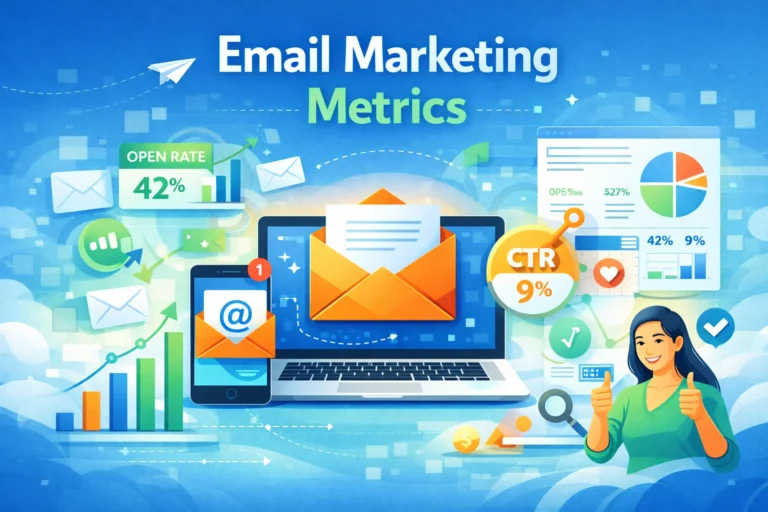
Measurement is where strategy becomes science. To optimize future campaigns, you must understand how past messages performed.
Key metrics include:
| Metric | What It Measures |
|---|---|
| Open Rate | Percentage of emails opened |
| Click-Through Rate (CTR) | Clicks on links within emails |
| Conversion Rate | Completed desired action |
| Bounce Rate | Emails that couldn’t be delivered |
| Unsubscribe Rate | People who opted out |
| Revenue per Email | Sales influenced by email |
Each metric tells a story. A low open rate suggests a need to improve subject lines. A high unsubscribe rate may indicate content misalignment with expectations.
Tracking metrics over time also exposes trends and campaign seasonality.
⚖️ Step 9 — Optimize Based on Data
Optimization means refining campaigns based on measurable insights.
What You Can Test:
- Subject lines
- Send times
- Segment definitions
- Email layout
- Frequency of messages
A/B testing (or split testing) is essential. Run tests with only one variable changed at a time to isolate impact.
Optimization isn’t a one-time task — it’s an ongoing cycle.
🧏♂️ Step 10 — Respect Compliance And Privacy
Email marketing isn’t free from rules. Growing global privacy laws mean you must follow best practices:
📌 Important Compliance Rules
- Permission required
All subscribers must opt-in to receive emails. - Clear unsubscribe options
Every email must let users easily opt out. - Transparency
Tell subscribers how you will use their data. - Data protection
Secure storage and responsible usage are essential.
Non-compliance damages deliverability and brand trust.
🧠 Why This Step-by-Step System Works
The effectiveness of email marketing lies in its repeatable framework. Each step feeds into the next, creating a cycle of:
- Strategy
- Collection
- Engagement
- Analysis
- Improvement
This loop — when executed consistently — drives long-term growth.
📥 Real-World Examples of How Email Marketing Works
Example 1 — eCommerce Email Workflow
- Visitor downloads a free style guide.
- They receive a welcome email.
- A few days later, they get a segmented offer on products they showed interest in.
- If they abandon cart, a reminder email triggers.
- After purchase, follow-up emails offer support and upsells.
This flow turns casual visitors into engaged customers.
Example 2 — SaaS Onboarding Sequence
- New subscriber signs up for a free trial.
- Day 1: Welcome + setup guide
- Day 3: Feature highlight
- Day 7: Case study showcase
- Day 14: Conversion offer
Each email moves the user closer to conversion based on behavior.
🚀 Best Practices to Improve Results
Here are key takeaways from the industry’s top performers:
- Keep messages relevant and personal
Segmentation boosts engagement. - Use concise and actionable subject lines
Clarity beats cleverness when it comes to opens. - Respect frequency
Too many emails lead to fatigue and unsubscribes. - Mobile-friendly design
Over 70% of emails are read on mobile devices. - Use data to guide decisions
Don’t guess — measure.
🔁 The Future of Email Marketing
Email continues to evolve with trends like:
- AI-assisted personalization
- Predictive segmentation
- Behavioral triggers
- Integration with SMS and messaging apps
- Privacy-first approaches
But the core principle endures: provide value and respect your audience.
📌 Final Thoughts
The step-by-step process of email marketing is not complicated, but it requires discipline, strategy, and data-driven execution. From building a quality list to optimizing campaigns based on performance metrics, each stage plays a critical role in delivering real results.
When done with intention and consistency, email marketing becomes more than a tool — it becomes a growth engine.
FAQ’s
1️⃣ How does email marketing work step by step?
Email marketing works through a structured process:
- Define your goal (sales, leads, engagement).
- Build a permission-based subscriber list.
- Choose an email service provider.
- Segment your audience.
- Create valuable email content.
- Set up automation workflows.
- Send or schedule campaigns.
- Track performance metrics.
- Optimize based on data.
Each step builds on the previous one, creating a repeatable system that drives measurable results.
2️⃣ What is the main purpose of email marketing?
The main purpose of email marketing is to build relationships with subscribers and guide them toward a specific action, such as making a purchase, signing up for a service, or engaging with content. It helps businesses communicate directly with their audience while maintaining full control over messaging and timing.
3️⃣ What tools are needed for email marketing?
To run email marketing campaigns effectively, you typically need:
- An Email Service Provider (ESP)
- Signup forms or landing pages
- A lead magnet (optional but recommended)
- Automation workflows
- Analytics tracking tools
Most modern ESPs combine all these features into one platform, making campaign management easier for beginners.
4️⃣ How long does it take to see results from email marketing?
Results from email marketing can begin immediately after launching a campaign, especially if you already have an engaged list. However, consistent and optimized performance usually develops over weeks or months as you refine segmentation, improve subject lines, test content, and analyze data trends.
5️⃣ What are the most common mistakes in email marketing?
Common mistakes include:
- Sending emails without clear permission
- Not segmenting the audience
- Writing misleading subject lines
- Ignoring mobile optimization
- Sending too frequently or inconsistently
- Failing to analyze performance metrics
Avoiding these mistakes improves engagement, deliverability, and long-term success.