In the modern digital marketing landscape, automation has become the backbone of successful customer engagement strategies. Whether you’re running an ecommerce store, a service business, or a growing membership site, the ability to automate tasks such as email sequences, behavioral follow‑ups, audience segmentation, and personalized messaging can significantly impact your growth — and your bottom line.
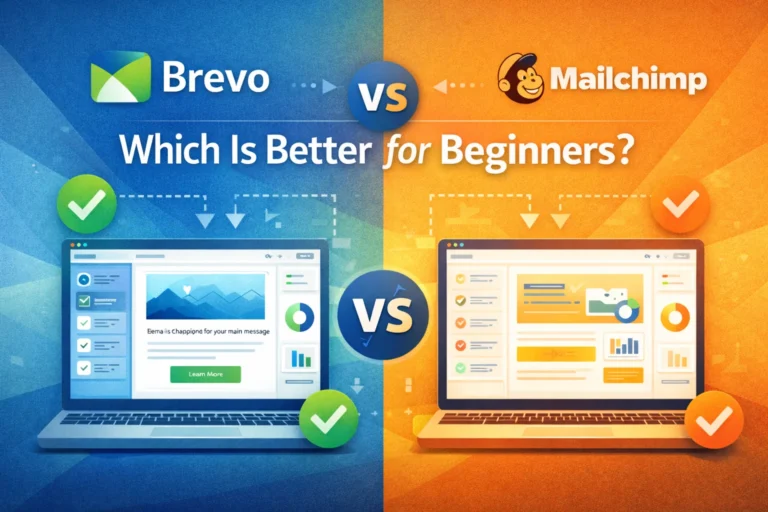
Two of the most widely discussed platforms for automation in 2026 are Brevo and ActiveCampaign. Both tools offer powerful automation capabilities but approach them from different perspectives and with distinct strengths.
This comprehensive, research‑based comparison will help you understand:
- What marketing automation really means in 2026
- How Brevo and ActiveCampaign each implement automation
- Which platform is more effective for small‑to‑medium businesses
- How their pricing, features, ease of use, and scalability compare
- Which tool is better for your specific use cases
By the time you finish this article, you’ll know exactly how each platform stacks up and which one offers better automation for your goals.
Table of Contents
- What Is Marketing Automation and Why It Matters
- Introducing Brevo and ActiveCampaign
- Automation Workflow Builders: Visual Interface Comparison
- Automation Triggers and Conditions
- Personalization and Dynamic Content
- Segmentation and Behavioral Targeting
- Tracking, Reporting, and Optimization
- CRM Integration and Lead Scoring
- Multichannel Automation
- Pricing Models and Value
- Ease of Use for Beginners
- Use Cases: Which Platform Excels Where?
- Pros and Cons
- Final Thoughts
1. What Is Marketing Automation and Why It Matters
Marketing automation refers to software systems that automatically perform marketing tasks based on predefined rules and user behavior. This can include:
- Sending a welcome email when a user subscribes
- Delivering abandoned cart reminders
- Triggering follow‑ups based on clicks or page visits
- Segmenting users automatically
- Personalizing content delivery
Automation helps businesses:
- Save time
- Improve consistency
- Increase conversions
- Personalize at scale
- Convert leads into paying customers
In 2026, automation isn’t just about sending emails — it’s about creating smart, adaptive journeys that respond to user actions in real time.
2. Introducing Brevo and ActiveCampaign
Brevo
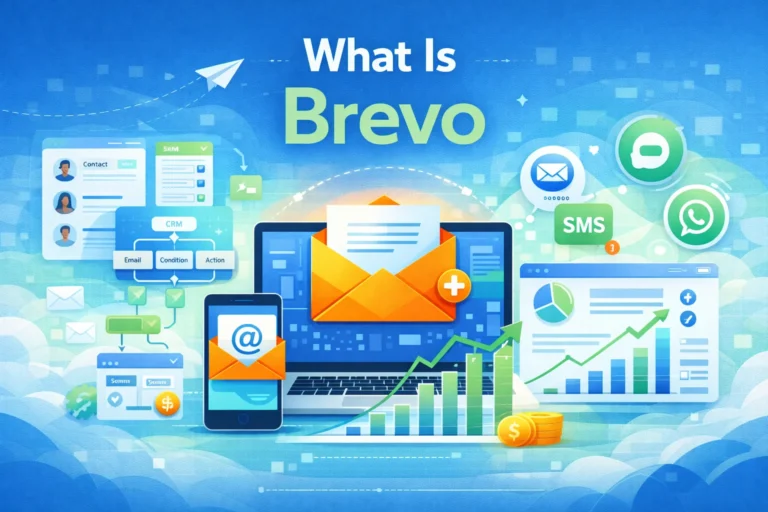
Brevo is an all‑in‑one marketing platform known for its affordable pricing model, email marketing, CRM, and multi‑channel messaging (SMS, WhatsApp, push notifications). Brevo’s automation features are solid and accessible, particularly for small and medium businesses that need straightforward workflows without a steep learning curve.
Brevo’s automation is included across plans, and even its free tier provides basic automation capabilities — making it a strong contender for beginners and budget‑conscious teams.
ActiveCampaign
ActiveCampaign, on the other hand, is widely regarded as one of the most robust automation platforms on the market. Its strength lies in complex automation, advanced customer journeys, dynamic personalization, and deep segmentation.
ActiveCampaign is often used by:
- Growth‑oriented businesses
- SaaS companies
- Ecommerce brands
- Agencies with advanced automation needs
While it commands a higher price point, ActiveCampaign’s depth of automation — including machine‑learning predictions, conditional logic, CRM integration, and sophisticated split testing — sets a high bar.
3. Automation Workflow Builders: Interface and Usability
One of the most fundamental aspects of any automation platform is the workflow builder — the visual tool you use to create sequences.
Brevo Workflow Builder
Brevo’s automation interface is:
- Visual and drag‑and‑drop
- Structured around “triggers,” “actions,” and “delays”
- Intuitive for beginners
- Focused on common automation flows like welcome series and behavioral triggers
You build workflows by defining a trigger (e.g., new subscriber added) and then adding subsequent actions such as sending an email or updating a tag.
Strengths
- Easy to understand
- Minimal setup for basic automations
- Good for straightforward sequences
Limitations
- Less granular control over branching compared to advanced builders
- Limited to standard action blocks and conditions
ActiveCampaign Automation Builder
ActiveCampaign’s workflow builder is one of its defining features. It offers:
- Highly visual, node‑based automation maps
- Complex branching logic
- Conditional waits, if/else statements
- Goal‑based actions
- Cross‑channel triggers
- Multi‑step automation with nested conditions
ActiveCampaign doesn’t just send emails — it lets you define behavior‑based journeys that adapt dynamically to user responses. You can create automations where different paths unfold based on:
- Clicked links
- Purchase history
- Engagement levels
- Form submissions
- CRM field changes
Strengths
- Sophisticated decision paths
- Conditional branching for highly personalized experiences
- Visual complexity without overwhelming clutter
Limitations
- Slight learning curve for absolute beginners
- More planning needed to map complex automation
4. Automation Triggers and Conditions
Triggers are the starting points for automation. The more trigger options you have, the more responsive and personalized your automation can be.
Brevo Triggers
Brevo includes common triggers such as:
- New contact added
- Email opened or clicked
- Specific page visited
- Custom event triggers (from API)
These triggers cover most small business and ecommerce needs but are less comprehensive than advanced platforms.
ActiveCampaign Triggers
ActiveCampaign supports a broader range of triggers, including:
- Contact score thresholds
- CRM deal changes
- Advanced goal completion
- Ecommerce specific events (added to cart, purchased)
- Tag or field updates
- Website tracking based on behavior
- Integration triggers from external apps
ActiveCampaign enables highly dynamic automation sequences based on granular user behavior.
5. Personalization and Dynamic Content
Delivering relevant messages hinges on smart personalization — and both platforms support this — but with different depth.
Brevo Personalization
Brevo allows personalization using merge tags such as:
- First name
- Location
- Custom fields
You can dynamically insert user details into subject lines or email content, which enhances relevance.
However, Brevo’s personalization features are relatively standard when compared to advanced tools.
ActiveCampaign Personalization
ActiveCampaign takes dynamic content further:
- Conditional email blocks based on user data
- Predictive content using behavioral scores
- Machine‑learning driven subject line suggestions
- Personalization based on site activity, past purchases, and custom fields
This enables automated emails that not only use first‑name variables but customize the entire message based on how a contact has interacted with your brand.
6. Segmentation and Behavioral Targeting
Segmentation allows you to group your audience according to behavior or characteristics.
Brevo Segmentation
Brevo lets you segment based on:
- Tags
- Custom fields
- Behavior (opens, clicks)
- Subscription source
This provides solid segmentation for most automation use cases, like targeting users who opened a specific email or purchased a product.
ActiveCampaign Segmentation
ActiveCampaign provides powerful segmentation features, including:
- Behavior and engagement scoring
- Predictive segmentation
- Complex rule sets using AND/OR logic
- Ecommerce segmentation based on purchase value, frequency, category, etc.
These capabilities give ActiveCampaign an edge for businesses that rely heavily on targeted messaging and personalized customer journeys.
7. Tracking, Reporting, and Optimization
Automation is only as good as its measurement. You need insights into how workflows perform and how contacts engage.
Brevo Reporting
Brevo provides:
- Open rates
- Click‑through rates
- Workflow engagement
- Conversion tracking (on higher plans)
- Basic funnel metrics
Reports are clear and actionable for small to mid‑range campaigns, but they lack deeper insights for complex funnels — such as predicting churn, revenue attribution, or heatmap engagement.
ActiveCampaign Reporting
ActiveCampaign’s reporting capabilities are rich and designed for analysis:
- Automation performance metrics
- Goal based reporting
- Conversion attribution
- Engagement maps
- Revenue tracking tied to automations
- Split test results
These features help marketers refine campaigns based on objective data rather than intuition.
8. CRM Integration and Lead Scoring
Brevo CRM Integration
Brevo includes a built‑in CRM on most plans, allowing you to:
- Store contact records
- Track interaction history
- Manage deals and pipelines
- Score leads with basic rules
CRM integration enhances automation by allowing workflows to trigger based on CRM actions like deal stage changes.
ActiveCampaign CRM & Lead Scoring
ActiveCampaign’s CRM is more sophisticated:
- Deep lead scoring based on multi‑factor behavior
- CRM pipelines with custom statuses
- Goal tracking and scoring actions
- Automated assignment based on rules
ActiveCampaign’s CRM works seamlessly with automation, making it a strong choice for businesses with defined sales and follow‑up processes.
9. Multichannel Automation
Automation isn’t limited to email alone — modern platforms support automation across multiple channels.
Brevo Multichannel
Brevo supports:
- Email automation
- SMS triggers
- WhatsApp communication
- Push notifications (in higher plans)
Integration of multiple channels allows businesses to reach contacts wherever they are, but the channels must be configured correctly and may incur additional costs for SMS or WhatsApp.
ActiveCampaign Multichannel
ActiveCampaign also supports multichannel automation:
- SMS
- Site messages
- Attribution analytics
- Third‑party integrations (e.g., Facebook custom audiences)
While SMS may require additional credits, ActiveCampaign’s multichannel automation is deep and well integrated with behavior tracking and CRM.
10. Pricing Models and Value
Brevo Pricing
Brevo’s pricing is based on email volume, making it easier to forecast costs as your contact list grows. Unlimited contacts on the free plan, and pay‑as‑you‑send structure helps small businesses control spend.
Plan tiers scale with feature availability, meaning basic automation is included early, and advanced functions unlock at higher levels.
ActiveCampaign Pricing
ActiveCampaign’s pricing is typically tiered based on contacts and feature sets.
Plans range from:
- Lite: Basic automation
- Plus: CRM and sales features
- Professional: Predictive content, optimization tools
- Enterprise: Dedicated support and custom features
ActiveCampaign generally costs more than Brevo — but offers deeper automation, analytics, and strategy tools that justify the investment for businesses with high engagement goals.
11. Ease of Use for Beginners
Brevo has a simpler learning curve, making it accessible for beginners who:
- Want basic automation
- Need a predictable pricing model
- Prefer an intuitive interface
ActiveCampaign, while highly powerful, requires:
- More planning to build complex automation
- Familiarity with segmentation logic
- Time to explore advanced features
For absolute beginners, Brevo may be easier to get started with — but for marketers ready to grow into more sophisticated automation, ActiveCampaign’s complexity becomes a strength.
12. Use Cases: Which Platform Is Better Where?
Best Uses for Brevo
- Small businesses with expanding contact lists
- Simple automation (welcome series, follow‑ups)
- Multichannel messaging with SMS and push
- CRM and email combination without external tools
- Budget‑conscious operations
Best Uses for ActiveCampaign
- Detailed customer journeys with branching logic
- Lead scoring and predictive automation
- Ecommerce automation with advanced segmentation
- Conversion optimization and revenue attribution
- Enterprise‑level automation strategies
13. Pros and Cons
Brevo Pros
✔ Predictable, volume‑based pricing
✔ Unlimited contacts on free plan
✔ Multichannel messaging options
✔ Integrated CRM features
✔ Easy to set up basic automation
Brevo Cons
✘ Less sophisticated automation logic
✘ Limited predictive analytics
✘ Workflow complexity capped at mid‑level features
ActiveCampaign Pros
✔ Advanced automation and conditional logic
✔ Powerful CRM and lead scoring
✔ Deep reporting and attribution
✔ Multichannel automation
✔ Ecommerce‑centric capabilities
ActiveCampaign Cons
✘ Pricing can be steep
✘ Learning curve for advanced workflows
✘ Some features require higher plan tiers
14. Final Thoughts: Which Offers Better Automation?
When comparing Brevo vs ActiveCampaign specifically on automation, it comes down to depth vs accessibility:
- ActiveCampaign clearly offers more sophisticated automation tools, with advanced triggers, conditional paths, predictive personalization, and deep analytics. It is ideal for businesses that plan to scale automation and use it as a core growth engine.
- Brevo delivers highly effective automation for small to mid‑sized businesses, especially those prioritizing simplicity, predictable pricing, and integrated communication channels. Its automation workflows are practical and easier to implement for beginners.
Bottom Line:
If your priority is powerful, flexible, data‑rich automation that adapts to complex marketing strategies — ActiveCampaign is the superior choice.
If your priority is cost‑effective, user‑friendly automation that integrates email, CRM, and messaging — Brevo is a compelling option.
FAQ’s
1️⃣ What is the main difference between Brevo and ActiveCampaign automation?
The main difference is complexity and depth. Brevo provides user-friendly automation workflows suitable for small to mid-sized businesses, focusing on email, SMS, and basic CRM triggers. ActiveCampaign offers advanced automation with conditional branching, predictive personalization, lead scoring, and multi-step sequences ideal for businesses with complex marketing needs.
2️⃣ Which platform is better for small businesses just starting with automation?
Brevo is generally better for beginners because it offers an intuitive workflow builder, easy setup, and predictable pricing. Its automation covers essential tasks like welcome emails, follow-ups, and behavioral triggers without overwhelming new users.
3️⃣ Can ActiveCampaign handle complex customer journeys better than Brevo?
Yes. ActiveCampaign supports multi-step automations with conditional logic, branching paths, and goal-based triggers, making it better suited for advanced customer journeys, lead nurturing, and personalized sequences. Brevo is simpler and effective for straightforward workflows.
4️⃣ Does Brevo support multichannel automation like ActiveCampaign?
Brevo supports email, SMS, WhatsApp, and push notifications, allowing basic multichannel automation. ActiveCampaign also supports multiple channels, with more advanced integration, behavioral triggers, and personalization, giving marketers finer control over multi-channel campaigns.
5️⃣ Which platform offers better value for automation features?
- Brevo offers cost-effective automation with predictable pricing based on email volume and unlimited contacts, making it ideal for small businesses on a budget.
- ActiveCampaign is more expensive but provides deeper automation capabilities, advanced personalization, and CRM integration, offering higher value for businesses that need sophisticated marketing automation.